It happens to almost all of us. You open the camera, switch on a filter, and within two seconds you see a different version of yourself. A slightly slimmer nose, fuller lips, bigger eyes, clearer skin, a more sculpted jawline. The result is impressive. So impressive that afterwards you look at your real self in the mirror and think: “Why don’t I look like that?”
There is nothing wrong with that thought. It is entirely human to want to see ourselves a little brighter, a little more rested. It is worth knowing, though, exactly what we are seeing on the screen, because what appears there is not a prediction of how you might look after a treatment. It is an image constructed by an algorithm, one that does not have to take into account the anatomical and biological limits of a real face.
How exactly does a filter “read” your face
An AI filter does not see your face the way a person sees it. It does not recognise expression, mood or beauty. It recognises points and coordinates.
The first step is to detect where a face exists within the frame. Then a second model lays a three-dimensional mesh over you. The system locates points such as the eye, the upper lip and the jaw, and tracks how they move when the face moves. From that moment on, it is no longer simply processing the image of a face, but a set of points that it can transform.
And it moves them. It pulls the jawline inwards, lifts the outer corner of the eye, widens the red of the lips, narrows the base of the nose. At the same time it smooths the texture of the skin and intervenes in the lighting, adding highlight in some areas and shadow in others, in order to create the impression of stronger features.
The most advanced filters can go even further, drawing on artificial intelligence models trained on large image databases. In this way they can modify the image in real time, frame by frame, keeping the result visually consistent even when the angle of the face or the lighting changes.
Why it looks so convincing
In the past, a filter was obviously a game. Dog ears, flower crowns. You passed your hand in front of the camera and the illusion fell apart. There was, in other words, a constant, silent reminder that this is not you.
Today that reminder has disappeared. You do not see a face that looks unnatural; you see a face that simply looks better. More symmetrical, smoother, closer to what you are used to seeing every day on social media. And precisely because it looks plausible, you forget that it is the product of computation. A digital image can appear entirely consistent with reality without necessarily being anatomically achievable.
What a filter cannot take into account
A beauty filter has one specific goal: to produce an image that is considered desirable within its own rules. The doctor works on a real face, that is, on skin, bone, cartilage, fat, muscle, blood vessels and nerves, with specific proportions and a specific way of healing.
A filter can move a feature by a few pixels without having to ask what lies underneath. It does not have to protect a nerve, preserve the function of the nose, anticipate swelling or manage a complication. And, above all, it does not have in front of it a person who will live with the result for years to come.
The nose is a characteristic example. A filter can make it extremely narrow, perfectly straight, with a particular tip and particular nostrils. In reality, however, the nose consists of a bony and cartilaginous framework, soft tissues and a functional relationship with breathing. Making it excessively narrow simply because it looks better that way on the screen may be neither achievable nor desirable.
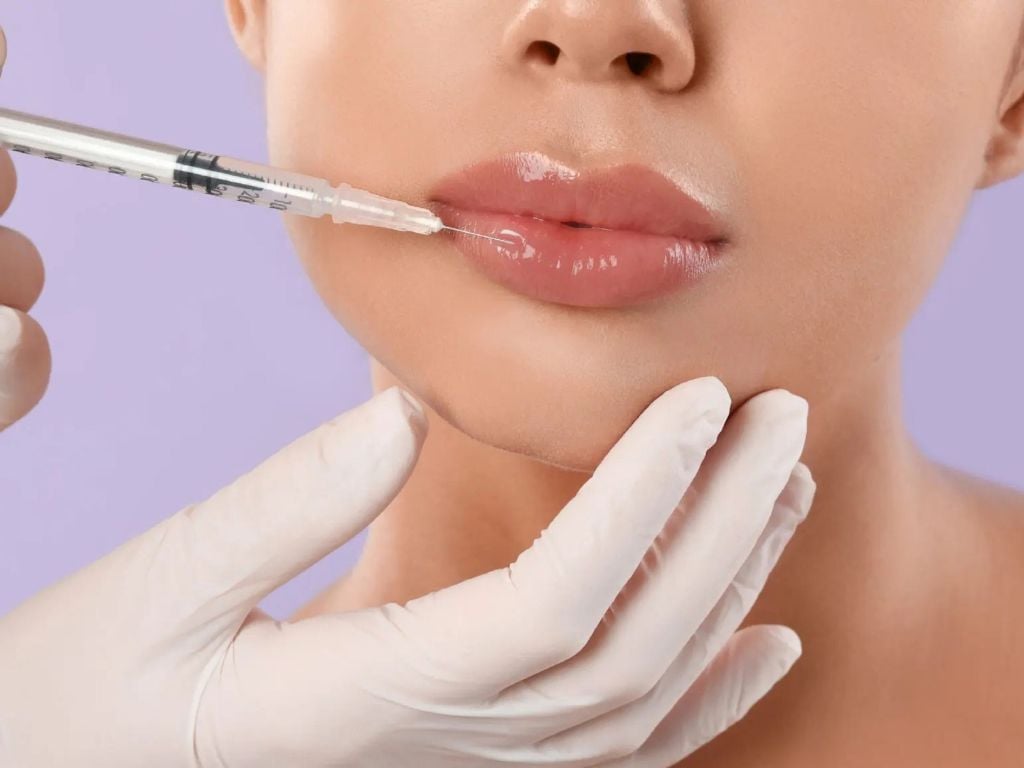
The same applies to the lips. On the screen, volume can be increased without any regard for the real limits of a treatment. In practice, injectable treatments require proper assessment, the right technique and a sense of measure. That is why “add a bit more until it looks like the filter” is not a realistic way to plan an aesthetic treatment.
When the mirror starts to look “wrong”
The most subtle point in this whole story is not a technical one. It is that, through repetition, the unnatural starts to look normal. If you see yourself every day with smoother skin, a slimmer nose and bigger eyes, the filter gradually becomes the new point of reference. And then the real mirror feels as though it is treating you unfairly. The mirror did not change; the standard of comparison did.
This creates a circle that closes on itself: real face, filter, improved image, comparison, dissatisfaction, more filter. And because the comparison is no longer made with an actress or a magazine cover but with your own, edited version, it becomes far more intense: it looks achievable. You do not think “I would like to look like her”, you think “this is how I should look”.
The international literature has described the phenomenon under the term Snapchat dysmorphia: patients who request aesthetic procedures aiming not at a celebrity, but at the filtered version of themselves. In a viewpoint article in JAMA Facial Plastic Surgery in 2018, researchers pointed out that such images can create an unattainable standard and blur the line between reality and fantasy. The term is useful for describing a trend, but it is not a diagnosis: wanting to improve something you do not like is one thing; persistent, disproportionate preoccupation with perceived flaws is another.
In adolescent girls and boys, self-image is still taking shape. The face genuinely changes, proportions shift, identity is put to the test. If at this stage the everyday image of the self is an algorithmically idealised version, the normal face may start to look lacking — not because it changed, but because what it is being compared with changed.
The issue is not the treatment, it is the expectation
Modern aesthetic treatments, when carried out by a specialist doctor with the right technique and individualised planning, can bring out the features of a face in a very natural way. The aim, however, is not to create a new face, but to improve harmoniously the one that already exists. And it is roughly here that the discussion about expectations begins.
A very common request today is to want to look like a specific photograph. Except that the photograph may have different lighting, a different shooting angle, make-up, editing or a digital filter. Even when an aesthetic procedure is entirely successful, comparing it with an edited image can create the feeling that something is missing. And then comes the need for a little more: slightly fuller lips, slightly stronger cheekbones, a slightly more defined jaw.
The aim, therefore, is not to reject aesthetic treatments or new trends. It is to distinguish desire from excessive demand. A treatment may be excellent, but it needs to serve the proportions and the features of that particular face, rather than trying to reproduce an image created on a screen.
This is precisely why medical assessment before any aesthetic procedure matters so much. The doctor does not simply look at one feature we want to change. They assess the face as a whole, its proportions, the age, the quality of the skin and its real needs. In this way, a general wish can be turned into a plan aimed at harmony and naturalness. Because ultimately, in aesthetic medicine, the impressive result is not necessarily the one that shows the most. It is the one that looks right on you. A face that looks more rested, more harmonious and fresher, without losing its own character. Because no filter can know what suits your own face; that is the work of an individualised medical approach.
How to talk about this with your doctor
Showing your doctor a photograph is not a mistake. On the contrary, it can help the conversation a great deal, as long as it works as a point of reference and not as a model to be copied. It can show what you like in a face or what change you would like to see, but the final result always needs to be adapted to your own features and your own proportions.
It is more useful to explain exactly what you want to improve and how you would like the result to look. For example, you may be interested in a more harmonious nose, a little more volume in the lips without losing their natural look, or a face that looks more rested. The more clearly you describe what concerns you in your real image, the more meaningful the conversation with your doctor can be.
And a few simple details can make a difference at the assessment appointment:
- Choose photographs without filters, taken from a normal distance and in neutral lighting. That way, the image you are both looking at is as close to reality as possible.
- Talk about what bothers you in the mirror and in your everyday life, not only about what you see on the screen. A phone camera and filters can significantly change the way we perceive facial proportions.
- Leave room for gradual decisions. Not every change has to be made immediately or to the maximum possible degree. A more conservative, individualised plan often allows you to assess better what you actually need.
- Listen to your doctor’s scientific opinion as well. If an option is not indicated for your particular features, or if you need to wait before going ahead, that is part of proper medical guidance. Assessment is not only about what can be done, but also about what is genuinely suitable for you.
In the end, a good aesthetic assessment appointment does not begin with trying to copy a face. It begins with explaining what you would like to change and letting the doctor show you how that can be done in a way that respects your own anatomy, your proportions and the naturalness of the result.
What a “natural result” actually means
Natural does not necessarily mean that no one can tell something was done. It means that the result suits that particular face: it respects its proportions, preserves its expressiveness and does not add a feature that looks foreign on it.
A good result does not have to be the most impressive one. Very often it is simply the one that makes you look more rested, more harmonious and closer to the image you have of yourself, without announcing that it came from a screen. And that is perhaps the most important element in aesthetic medicine: the procedure should adapt to the face, not the face to the procedure.
The modern aesthetic approach is not based on one specific standard of beauty. Every face has different needs and a different way of evolving over time. The goal is not to change everything, but to identify those points that can genuinely improve the overall picture.
At CDM, aesthetic medicine is treated as an individualised process. The choice of the right treatment, the technique and the combination of procedures cannot come from a filter or from a photograph on social media. They require knowledge, experience and, above all, an understanding of the face in front of you.
The choice of doctor and clinic matters
A proper aesthetic procedure begins long before the treatment itself. It begins with the choice of the right doctor and of the organised medical environment in which it will be carried out. Assessing the request, having an honest discussion about what is realistically achievable and selecting the appropriate technique are just as important as the procedure itself.
At Cosmetic Derma Medicine, every face is treated as unique. The plan is not based on ready-made formulas or on one particular standard of beauty; it is designed around the features, the proportions, the age and the needs of each person. This philosophy allows aesthetic treatments to work in a way that complements natural features, aiming for a harmonious and natural result.
Equally important is proper information at every stage. The doctor needs to explain clearly what a treatment can offer, which result is realistic and which options are most suitable for that particular face. Sometimes the best decision may be a milder procedure, a gradual plan, or even waiting until the right conditions are in place. The quality of an aesthetic approach is judged not only by what can be done, but also by the ability to choose what is right for each person.
Because a truly successful result is not the one that follows a trend faithfully, nor the one that copies an image. It is the one that remains beautiful and harmonious on you, even when the trend changes and the filter leaves the screen.
If you are considering an aesthetic procedure and want to understand what can realistically be done in your case, the first step is a proper assessment. At Cosmetic Derma Medicine, our specialists can discuss your needs and expectations with you, assess the features of your face and propose an individualised plan, with harmony, naturalness and safety as the priority.
No ready-made templates. No filters. Just your own face and the approach that genuinely suits it.
Contact the clinic +30 210 6980451