We pay attention to our face almost every day: serum, moisturiser, sunscreen, treatments and perhaps a little extra care around the eyes. Yet just a few centimetres lower lies an area that is often left out of this routine: the neck. Until a fine horizontal line begins to look deeper, the skin loses some of its firmness or the jawline no longer appears as clearly defined. That is when the familiar question arises: is the neck ultimately the area that reveals our age?
The answer is not so simple. The neck can indeed make certain age-related changes more visible, and there is a scientific reason for this. The skin, muscles, subcutaneous fat and support provided by the lower jaw change over time, affecting the appearance of the area differently from the central face.
Neck ageing, therefore, is not a single concern. It results from different anatomical and skin changes that develop gradually.
Why Can the Neck Show Signs of Ageing Earlier?
The neck occupies a distinctive position. It is exposed to the sun, moves constantly and is covered by skin with different biomechanical properties from facial skin.
In a study comparing neck skin with cheek skin in women of different ages, the dermal layer of the neck was found to be thinner, while its elasticity showed a strong negative correlation with age. The researchers also observed that neck wrinkles were associated with age, elasticity and transepidermal water loss.
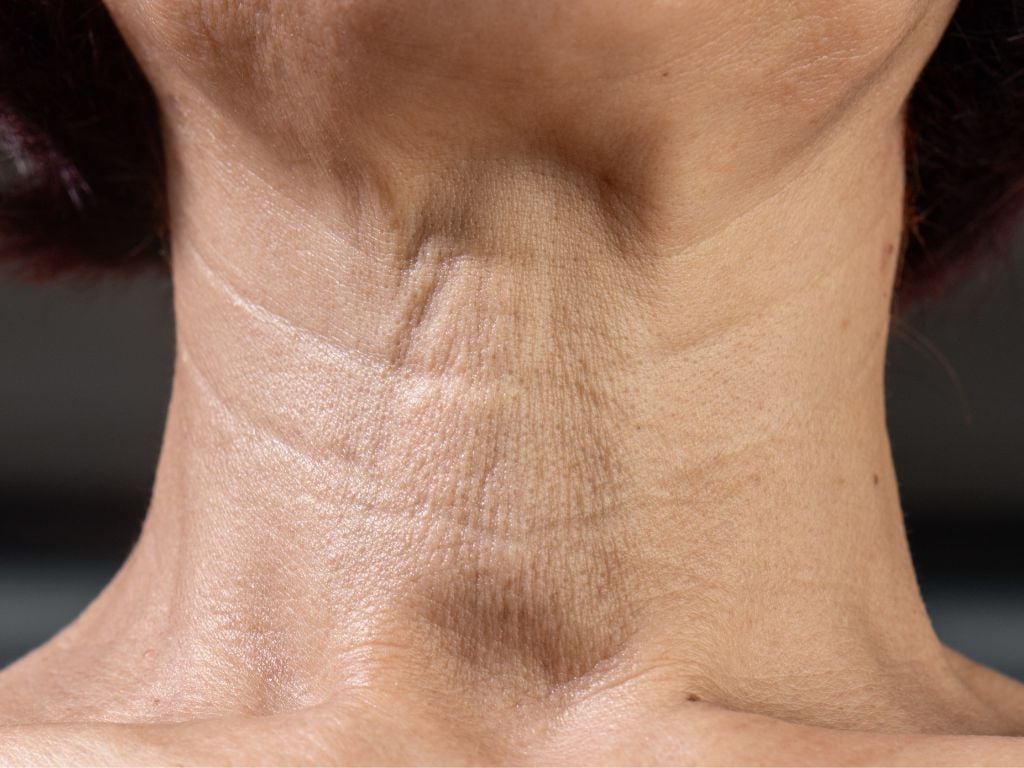
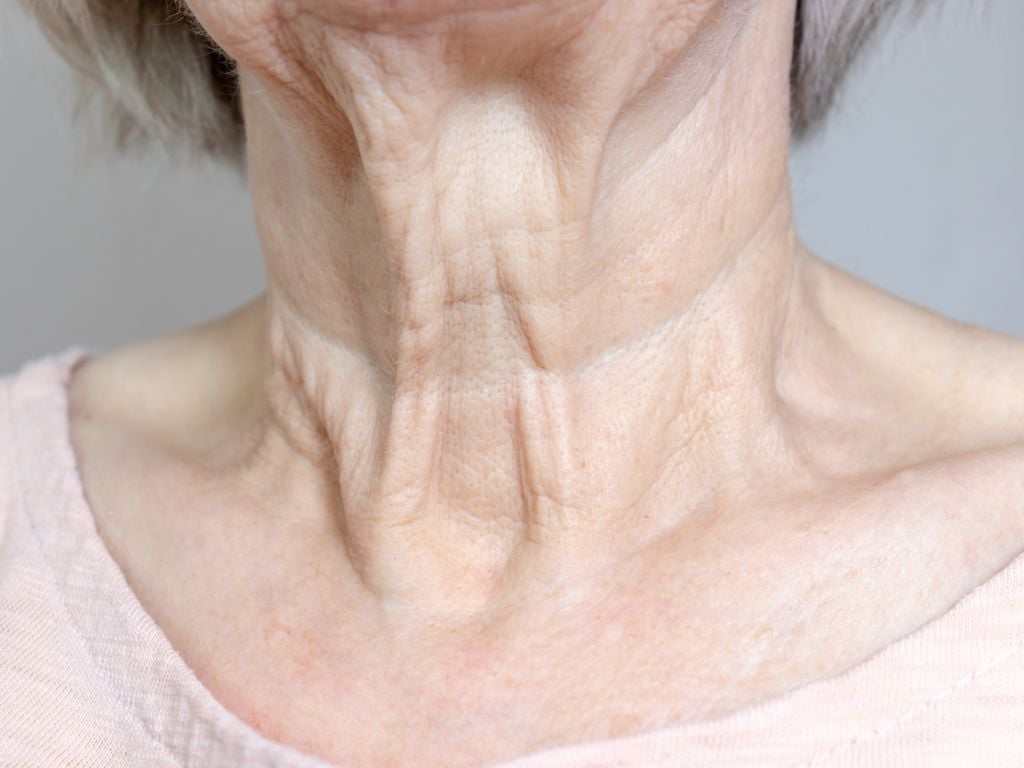
Over time, collagen and elastic fibres undergo changes, meaning that the skin does not return to its original position as easily after movement and deformation. Fine lines may become more persistent, the surface may appear thinner and more crepey, and skin laxity may gradually develop.
However, the skin is not the only factor.
Neck Ageing Occurs at More Than One Level
The appearance of a youthful neck depends on the balance of several different structures. Over time, the quality and elasticity of the skin may change, the distribution of fat beneath the chin may shift, support from the lower jaw may decrease and the action of the platysma muscle may become more visible.
The platysma is a thin, broad muscle extending from the chest and neck towards the lower jaw. When its muscle bundles become more visible, they can create the characteristic vertical neck cords known as platysmal bands.
At the same time, changes in the soft tissues and skeletal support of the lower face can affect the jawline and contribute to the appearance of jowls.
This is why two women of the same age may have completely different-looking necks. Fine lines and photoageing may predominate in one woman, platysma activity in another, and skin laxity or loss of jawline definition in a third.
Therefore, not every neck requires the same treatment.
The Sun Remains One of the Most Important Factors
If there is one daily habit worth extending from the face to the neck and décolletage, it is photoprotection.
Chronic exposure to ultraviolet radiation causes changes in collagen and elastic fibres and is one of the most important mechanisms of photoageing. Clinically, this may appear as wrinkles, uneven texture, pigmentation irregularities and reduced elasticity.
There is another particularly interesting finding: in a 4.5-year randomised study, the group that used sunscreen daily showed significantly less progression of photoageing than those who used it at their discretion.
A common mistake is to apply SPF only as far as the jawline. In reality, the neck and décolletage require the same consistency as the face.
Tech Neck: Is Your Phone Really Responsible for Neck Lines?
In recent years, the term tech neck has been used to describe horizontal lines visible on the neck, particularly at younger ages.
Frequently bending the head towards a phone does alter head position and increase mechanical strain on the neck. Studies have shown that prolonged smartphone use in a flexed position affects posture and may contribute to musculoskeletal symptoms.
An important clarification is needed, however: there is insufficient evidence to conclude that phone use alone causes permanent premature skin ageing.
Repeated movements and folds may make existing lines more noticeable. However, not every horizontal crease should be treated as smartphone-related damage. Anatomical neck lines may be present even at a very young age.
What Changes in Women’s Skin Around Menopause?
There is another factor that deserves particular attention in an article addressed to women: hormonal changes.
The decline in oestrogen during and after menopause is associated with changes in hydration, elasticity, skin thickness and collagen content. For many women, this is a period when dryness, a thinner texture and laxity may become more noticeable.
Hormonal changes are therefore another factor affecting tissue that is already undergoing natural age-related changes.
Can Daily Skincare Make a Real Difference?
Neck care does not need to begin only when pronounced laxity appears. Consistent photoprotection is probably the most important first step.
At the same time, a moisturising formula that supports the skin barrier can help improve dryness and the appearance of fine lines.
Retinoids are also supported by substantial evidence in the management of photoageing. Studies of topical vitamin A derivatives have demonstrated improvements in wrinkles, texture and other characteristics of photodamaged skin. More recent clinical research focusing specifically on the neck has shown improvements in fine lines, texture, laxity and crepey appearance following the consistent use of a retinol product.
However, the neck may be more prone to irritation than the face. Potent active ingredients should be introduced gradually and, particularly when prescription retinoids are used, under the guidance of a dermatologist.
When Skincare Is Not Enough, Treatment Should Address the Cause
The most important principle in the modern management of neck ageing is that the question is not simply, “What is the best treatment?” but rather, “What exactly is creating this appearance?”
Fine lines and photoageing, horizontal creases, platysma activity, skin laxity, changes in submental fat or loss of jawline definition may predominate. In many cases, more than one of these features is present.
This distinction matters because different treatments target different tissue levels. Treating a muscular band does not have the same objective as a treatment designed to improve skin texture, while significant laxity is not managed in the same way as a superficial wrinkle.
When Vertical Bands Predominate: Treating the Platysma
When vertical muscular bands are the main concern, botulinum toxin treatment of the platysma, also known as the Nefertiti Lift, targets muscle activity rather than skin quality.
The aim is to reduce overactivity in specific parts of the platysma so that the vertical bands become less visible and, in suitable patients, the transition from the lower jaw to the neck appears more refined.
Accurate anatomical knowledge and appropriate patient selection are particularly important, as this treatment is not suitable for every form of laxity and does not replace a surgical lift when there is significant excess tissue.
When the Main Concern Is Skin Quality
Fine wrinkles, pigmentation irregularities, rougher texture and certain features of photoageing require a different approach.
Fractional CO₂ Laser creates controlled microscopic zones of thermal injury, activating healing mechanisms and collagen remodelling.
Clinical studies of fractional laser treatment on the neck have reported improvements in wrinkles, texture and laxity. More recent data on non-ablative fractional lasers have also shown wrinkle improvement and an increase in measured dermal thickness following a course of treatments.
However, the neck is not necessarily treated with the same parameters as the face. Its anatomy and the different behaviour of its tissues require an individualised approach.
When Jawline Definition Has Been Lost
Sometimes, the feature that makes the neck appear older is not located in the neck itself.
Over the years, the skeletal support and soft tissues of the lower face change. As a result, the jawline may become less defined and the transition between the face and neck may alter.
In selected cases, hyaluronic acid in the jawline or chin may be used to restore some structural support and improve contour. Its purpose is not to “fill the neck”, but to influence the overall architecture of the lower face.
When Mild to Moderate Laxity Predominates
COG threads are another option for the non-surgical lifting of selected areas of the jawline and neck.
These specialised barbed threads are placed within the tissues to provide mechanical support and help improve contour. Their presence in the tissues may also activate processes associated with collagen production, gradually supporting the quality and firmness of the area. The technique may be an option for individuals with mild to moderate laxity who want to improve contour without surgery. The appropriate technique, number and placement of threads are individualised according to each person’s anatomy and degree of laxity.
Ultimately, Does the Neck Reveal Your Age?
Perhaps the most accurate answer is that the neck does not reveal age as much as it reflects the combined changes that have occurred in its tissues over the years.
It reflects sun exposure, changes in collagen and elastin, muscle activity, changes in the soft tissues and the structure of the lower jaw. In women, it is also affected by the hormonal changes associated with menopause.
Perhaps, then, it is time to stop treating the neck as the area that is simply left over after facial skincare.
Neck care can begin simply: daily photoprotection, appropriate moisturisation and the careful use of active ingredients. When changes become more pronounced, however, assessment should include not only the skin’s surface but the entire anatomy of the neck and lower jaw.
A consultation appointment with a specialist can help identify which factor predominates in each individual case and which treatment options may provide meaningful benefit. The right approach does not begin with a treatment, but with an individualised assessment.